|
*Winner of 2024 Flora Tristán Prize for Best Book on Peru, Peru Section, Latin American Studies Association
*Honorable Mention, 2024 SLACA Book Prize, American Anthropological Association |
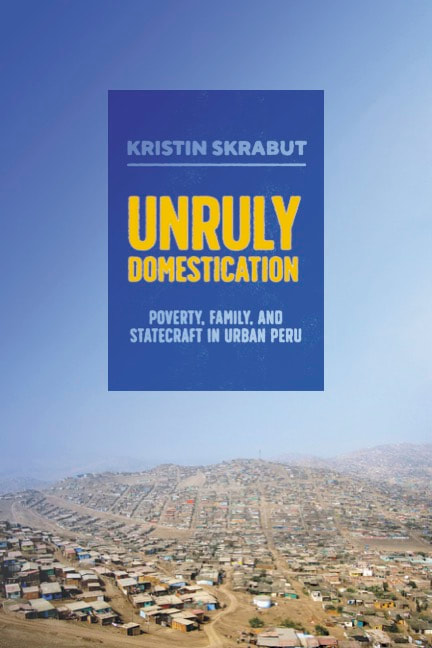
Unruly Domestication investigates how Peru’s ongoing, internationally endorsed "war on poverty" shapes politics, intimate identities, and urban space in Lima. Drawing on a decade of embedded, ethnographic research in Lima’s largest and most recently founded “extreme poverty zone,” Kristin Skrabut demonstrates how Peru’s efforts to fight poverty by formalizing property, identity, and family status perpetuate environmentally unsustainable urban sprawl, deepen discrimination against single mothers, and undermine Peruvians’ faith in public officials and in one another. In the process, Skrabut reveals myriad entanglements of poverty, statecraft, and private life, exploring how families are made and unmade through political practices, how gender inequalities are perpetuated through policy, and how Peruvians’ everyday pursuits of state-sanctioned domestic ideals reproduce informality and landscapes of poverty in the urban periphery.
The only full-length ethnography written about Lima’s iconic and policy-inspiring shantytowns in thirty years, Unruly Domestication provides valuable insight into the dynamics of housing and urban development in the Global South, elucidating the most intimate and profound effects of global efforts to do good. Purchase at University of Texas Press Purchase at Amazon.com |
Praise for Unruly Domestication
Kristin Skrabut is a skilled ethnographer, whose fieldwork interweaves accounts from residents, community leaders, and others, showing how individuals have agency but also are caught up in processes beyond their control. She pays attention to the complex nuances of terminology and explains her own choices. Her fascinating observations will be welcomed by many scholars. ~Susan Bibler Coutin, University of California, Irvine author of Exiled Home: Salvadoran Transnational Youth in the Aftermath of Violence
A beautifully written and richly detailed book that boldly reconceptualizes the complex dynamics of poverty and gender, governance and relatedness. Unruly Domestication offers much for anyone concerned about the impact of state power on individual lives. ~Krista E. Van Vleet, Bowdoin College, author of Hierarchies of Care: Girls, Motherhood, and Inequality in Peru
One of the book’s greatest contributions is its attempt to comprehensively characterize the everyday lives of the urban poor in a format reminiscent of classical ethnographic monographs in our discipline. Skrabut has an exceptional ability to conceptually elaborate on longer-term processes specific to the Global South from particular ethnographic evidence...Unruly Domestication stands out for its methodological rigour, rich ethnographic description, and the thought-provoking theoretical elaborations offered by the author. The book isa must-read for anyone interested in understanding how anti-poverty policies affect the way the urban poor of Latin America experience and make sense of their everyday lives in contexts of vulnerability and everyday interactions with the state. ~Social & Cultural Geography
As a Peruvian scholar from Callao who studies the region, I appreciate the depth with which the book engages with the experiences of poverty, especially through the lens of women’s lives… Skrabut’s ethnographic approach further enhances the book’s contribution by grounding abstract concepts in the realities of daily life, offering a vivid portrayal of the intersection between statecraft, identity, and marginalization…[This book] serves both as a call to critically engage with the politics of poverty and as a reminder of the importance of centering the voices of those living on the margins. ~Contemporary Sociology
[This] persuasive study...offers a comprehensive examination of formalization as a contested space—where the state’s mechanisms of governmentality collide with the political and moral economies of the disenfranchised majority...Unruly Domestication is a significant intellectual contribution that deserves the attention of scholars of both urban and rural contexts—within Peru and beyond. Its insights into statecraft, civil society, moral economies, and poverty as contested terrain between competing rationalities and governmentalities are both substantial and compelling. Although conceptually and theoretically dense, the book remains accessible to nonspecialists. ~Journal of Urban Affairs
A beautifully written and richly detailed book that boldly reconceptualizes the complex dynamics of poverty and gender, governance and relatedness. Unruly Domestication offers much for anyone concerned about the impact of state power on individual lives. ~Krista E. Van Vleet, Bowdoin College, author of Hierarchies of Care: Girls, Motherhood, and Inequality in Peru
One of the book’s greatest contributions is its attempt to comprehensively characterize the everyday lives of the urban poor in a format reminiscent of classical ethnographic monographs in our discipline. Skrabut has an exceptional ability to conceptually elaborate on longer-term processes specific to the Global South from particular ethnographic evidence...Unruly Domestication stands out for its methodological rigour, rich ethnographic description, and the thought-provoking theoretical elaborations offered by the author. The book isa must-read for anyone interested in understanding how anti-poverty policies affect the way the urban poor of Latin America experience and make sense of their everyday lives in contexts of vulnerability and everyday interactions with the state. ~Social & Cultural Geography
As a Peruvian scholar from Callao who studies the region, I appreciate the depth with which the book engages with the experiences of poverty, especially through the lens of women’s lives… Skrabut’s ethnographic approach further enhances the book’s contribution by grounding abstract concepts in the realities of daily life, offering a vivid portrayal of the intersection between statecraft, identity, and marginalization…[This book] serves both as a call to critically engage with the politics of poverty and as a reminder of the importance of centering the voices of those living on the margins. ~Contemporary Sociology
[This] persuasive study...offers a comprehensive examination of formalization as a contested space—where the state’s mechanisms of governmentality collide with the political and moral economies of the disenfranchised majority...Unruly Domestication is a significant intellectual contribution that deserves the attention of scholars of both urban and rural contexts—within Peru and beyond. Its insights into statecraft, civil society, moral economies, and poverty as contested terrain between competing rationalities and governmentalities are both substantial and compelling. Although conceptually and theoretically dense, the book remains accessible to nonspecialists. ~Journal of Urban Affairs